In the long history of America’s Got Talent, we have seen everything from fire-breathers to opera-singing children. But there is one category that has historically been the “final frontier” of animal acts: domestic cats. While dogs live to please their owners, cats are famously independent, leading to the age-old comedy trope that “herding cats” is the hardest job in the world. That was, until Svitlana and Marina Savitsky walked onto the stage.
The Savitsky Cats didn’t just perform a routine; they staged a full-scale feline takeover that shattered every stereotype about the species.
The Challenge of the “Un-Trainable”
Before the music even started, the judges were skeptical. Simon Cowell, a noted dog lover, has spent years on the panel dismissing cat acts, often noting that cats simply do what they want, when they want. The Savitsky family, hailing from Ukraine, admitted that their journey wasn’t easy. It takes nearly a year to teach a single cat a new behavior, mostly because, as Marina joked, cats believe humans are the slaves and they are the masters.
A Masterclass in Precision
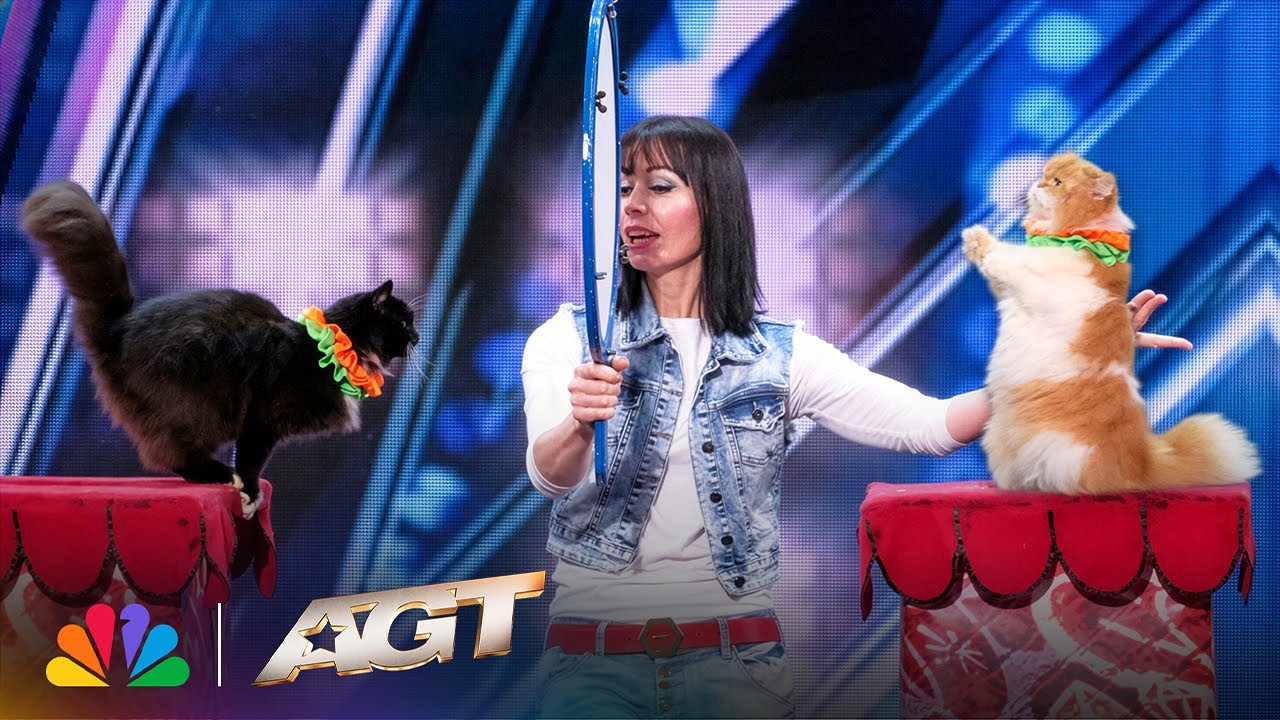
When the performance began, the skepticism in the room instantly evaporated. What followed was a high-octane, perfectly choreographed display of agility and intelligence. These weren’t just house cats sitting on command; these were feline athletes.
The cats executed a series of increasingly difficult stunts, including vertical climbs, complex weaving between obstacles, and synchronized jumps. The most breathtaking moments involved the cats leaping through narrow hoops and performing high-wire balance acts that required immense focus—something cats aren’t exactly known for in high-pressure environments. The sheer speed of the routine kept the audience on the edge of their seats, as one cat after another completed its task with “cat-itude” and flair.
The “Simon Cowell” Effect
The true test of any AGT act is winning over Simon Cowell. Throughout the performance, the cameras caught Simon moving from a look of doubt to one of genuine wonder. By the end of the set, the man who “isn’t a cat person” was forced to admit that he had witnessed something historic.
Howie Mandel summarized the feeling in the room perfectly, noting that while we see these tricks done by dogs constantly, seeing a cat perform them with such enthusiasm is a rarity that borders on the miraculous. The judges were impressed not just by the tricks, but by the obvious bond and trust between the trainers and their ten feline stars.
Why It Went Viral
The Savitsky Cats became an instant viral sensation because they tapped into a universal human curiosity: Can cats actually be taught? The answer provided by this performance was a resounding “Yes.”
Beyond the technical skill, the act succeeded because it was joyful. In a world of high-stakes competition, there was something inherently delightful about watching a group of pampered cats outshine human acrobats. They proved that with enough patience, love, and perhaps a few treats, even the most independent creatures on earth can become world-class entertainers.
The Savitsky Cats didn’t just get four “yeses” that night; they paved the way for a new era of animal acts, proving that in the world of talent, there are no “un-trainable” species—only trainers who haven’t yet found the right motivation.